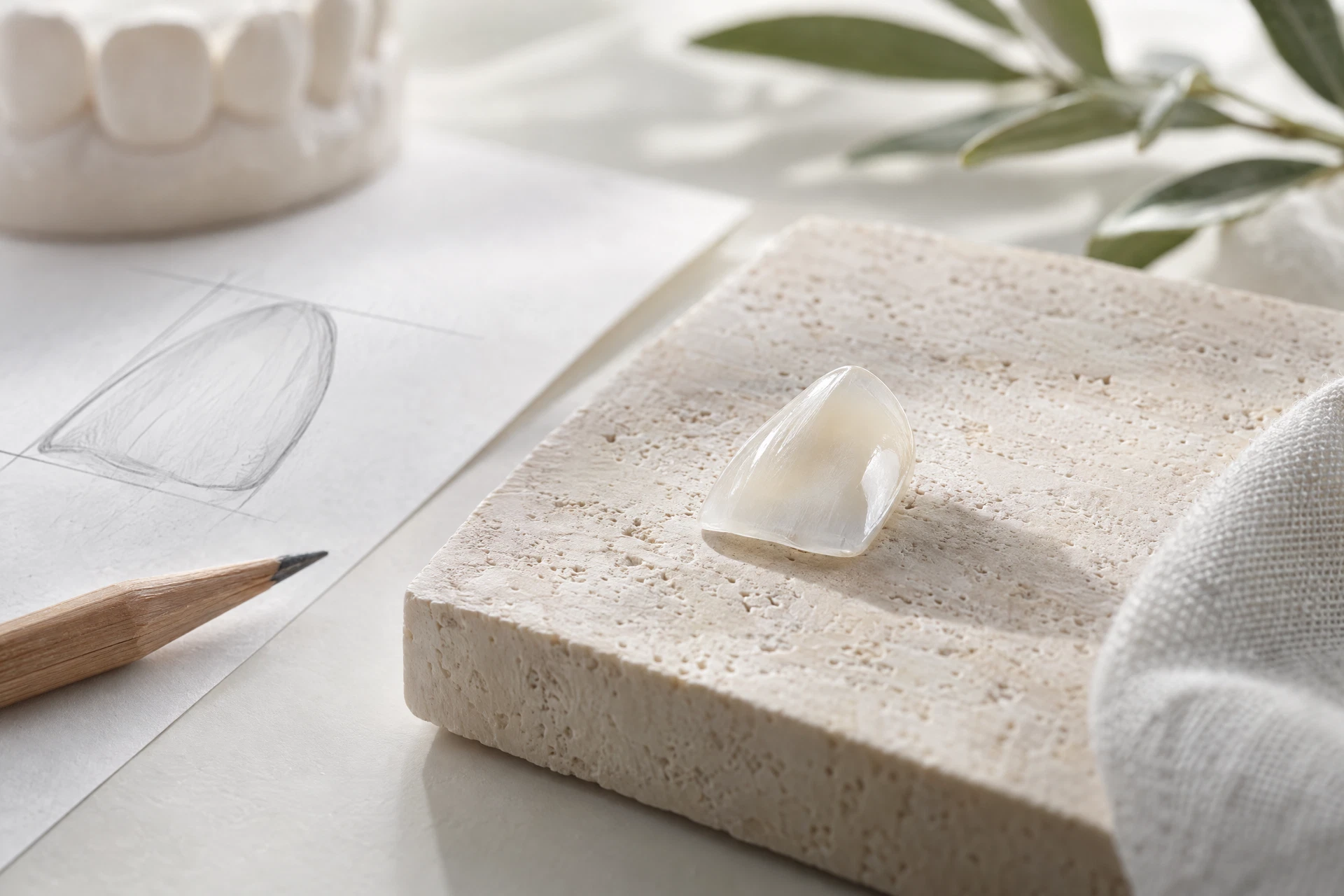
For a London patient considering porcelain veneers, the key question is not simply whether teeth will be ‘filed down’. It is whether the proposed design can achieve a healthy, natural-looking result while retaining as much enamel as possible. This article explains conventional, minimal- and no-preparation approaches; when a temporary may be used; and why removal or replacement is not the same as returning a prepared tooth to its original state.
What to keep in view
- Enamel preservation is a treatment objective, not a marketing claim: the planned final contour and bite determine whether space must be created.
- ‘No-prep’ is selective; it may suit some additive changes but can produce excess bulk or gum problems where there is too little space.
- Once enamel is removed it does not regrow, so a prepared tooth generally enters a long-term cycle of maintenance, repair or replacement rather than being restored to its original state.
- Temporaries are case-dependent: they may be used while a laboratory-made veneer is produced, but are often unnecessary for very minimal or no-prep plans.
- For an elective cosmetic procedure, patients should receive clear alternatives, risks, likely prognosis and time to decide before consenting.
Five patient questions
Clear answers, with the context that matters.
01Does a porcelain veneer always require enamel to be removed?+
Not always, but conventional porcelain-veneer treatment commonly includes removing a small amount of enamel from the front and sometimes sides of the tooth to create space for the ceramic. The amount and position of any preparation should be driven by the planned change in shape, position and colour, plus the tooth’s existing enamel and bite. Preserving an enamel bonding surface is desirable: a literature review found reasonable evidence that preparations extending into dentine adversely affect veneer survival, although veneers can still fail even when enamel is retained.
For your own situation: Only an examination, bite assessment and treatment design can show whether preparation is needed for your teeth and how much enamel can safely be retained.
02Are ‘no-prep’ veneers better — and are they genuinely reversible?+
No-prep means the plan aims to place an ultra-thin veneer without intended tooth reduction; it is not a universal option or a guarantee of a better result. It may be more suitable when teeth are small or set back and only a modest additive change is wanted. If there is insufficient space, adding ceramic without reduction can leave teeth over-contoured or irritate the gums. A systematic review concluded that the evidence was insufficient for a definitive clinical statement about the no-prep technique. Where no tooth structure has actually been altered, later removal may be more conservative, but this should not be presented as a promise that every case can simply be ‘undone’.
For your own situation: Whether a no-prep design is suitable, and what can realistically be reversed, requires an in-person examination and a planned preview of the proposed result.
03What does ‘preparation’ involve, and how is enamel loss kept to a minimum?+
Preparation is not a standard fixed amount of drilling. It is the controlled reshaping needed, if any, to make room for a veneer of appropriate thickness and contour. Reviews describe planning the intended final shape first and using guides or depth-control methods rather than freehand reduction alone, because both under-preparation (a bulky result) and over-preparation (unnecessary dentine exposure) are possible. Preparation that removes enamel is irreversible: the lost enamel does not grow back.
For your own situation: The appropriate preparation design depends on your enamel thickness, existing fillings or wear, tooth colour, alignment and bite, so personal advice needs a clinical examination.
04Will I need temporary veneers while the porcelain ones are made?+
Possibly, but not in every case. A conventional porcelain veneer is usually made by a laboratory after a scan or impression, and a temporary veneer may be worn in the interval. With very limited or no preparation, an interim restoration may not be required. A temporary is a short-term stage of treatment, not evidence that the final treatment is reversible; the important question is whether enamel has been altered and what the long-term plan is if a veneer later needs repair or replacement.
For your own situation: Whether you need temporaries, and how they will be retained and looked after, can only be decided after an examination and review of the planned preparation.
05If I later change my mind or a veneer fails, can I go back to my natural tooth?+
If enamel was removed, the tooth cannot be returned to its original pre-treatment form; it will normally need ongoing restorative management, which may mean repair or a replacement veneer. Veneers are not lifetime, failure-proof treatment: the evidence review found survival is rarely 100%, and fracture, chipping and debonding are recognised complications. Before agreeing to elective treatment, a dentist should explain reasonable alternatives, material risks and benefits, likely prognosis, costs, what happens if treatment is not done, and give you time to consider this information.
For your own situation: Your own long-term options depend on the amount of remaining enamel, the condition of each tooth and your bite, all of which need a clinical examination.
Clinical & regulatory sources
Explore the source material.
These sources informed this guide. They support general education and do not replace an examination or personalised advice.
Take this guide into a consultation and ask how the information applies to your teeth, gums, bite and goals.
Open the consultation guide ↗